
The National Ploughing Championships might have farming at its heart, but anyone who has attended over the years knows it’s become much more than that.
For three days, it’s also a gathering place for tens of thousands of families and homeowners from towns, villages and rural communities across Ireland.
Activ8 Solar Energies will be there again this September, and we’re expecting to have plenty of conversations about one subject in particular: the cost of powering our homes.
For people living outside Ireland’s larger towns and cities, that conversation can be slightly different.
Detached homes are common and properties can be larger. Two cars may be a necessity rather than a luxury. Oil heating remains familiar in many homes. And with fewer options for public transport, switching one – or both – of those cars to electric can make an increasingly noticeable difference to household electricity use.
So, does living in rural Ireland make solar panels more or less worthwhile?
For many homes, there are some very good reasons why the answer could be more.
Why Rural Homes Can Be Well Suited to Solar Panels
There isn’t really such a thing as a typical rural Irish home. Indeed, recent proposals signed off by Government could make it easier to build one-off housing nationwide.
It could be a bungalow built during the 1970s, a two-storey farmhouse that’s been in the family for generations, or a large detached house built during the Celtic Tiger years.
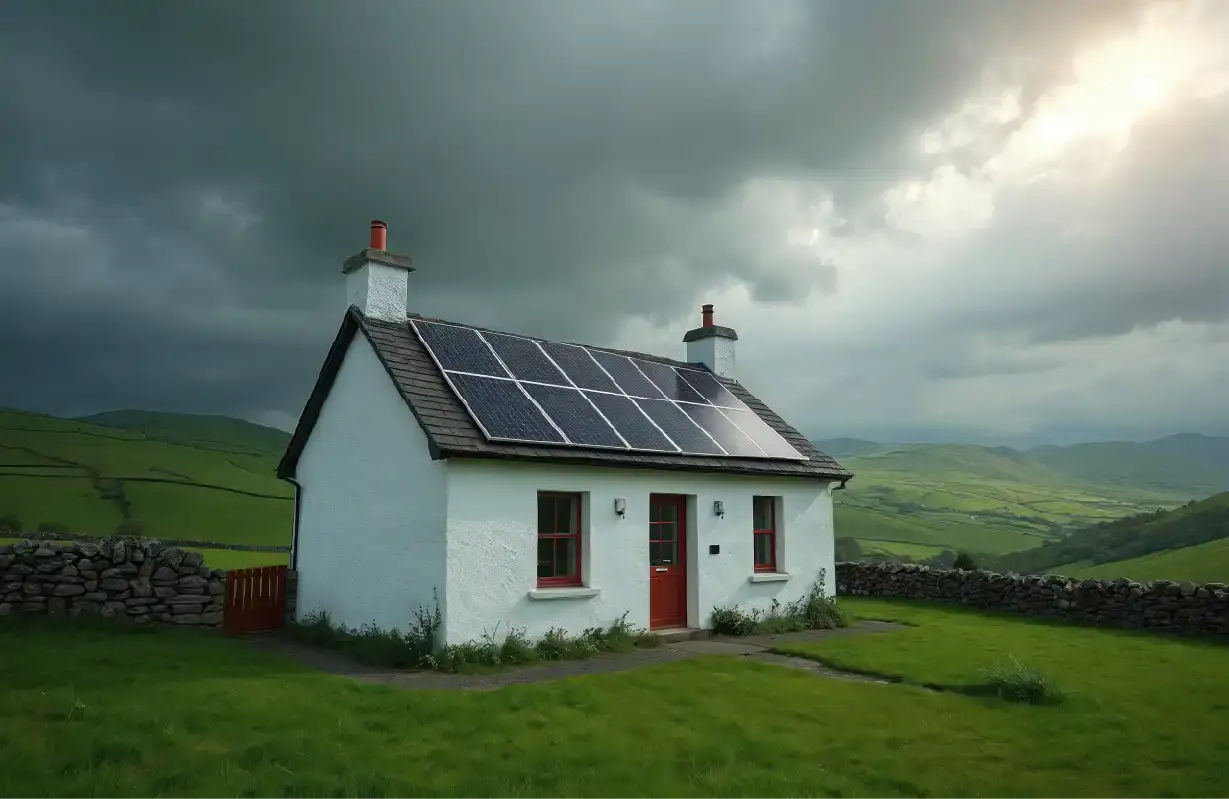
But many share characteristics that can work particularly well for solar.
Larger detached homes often have more available roof space than terraced or semi-detached properties in urban areas. They may also have garages, sheds or other buildings that can potentially form part of the conversation when assessing a property.
More space doesn’t automatically mean a home is suitable for solar. Roof condition, orientation and shading from nearby trees or buildings all matter. That’s why every property needs to be assessed individually.
Do Solar Panels Work in Rural Ireland?
You don’t need to live somewhere with Mediterranean sunshine to make solar panels worthwhile.
Solar PV panels generate electricity from daylight and continue to produce electricity on overcast days, although output will naturally be lower than on bright sunny days.
In fact, around 75% of the annual electricity generated by a solar PV system in Ireland is produced between May and September.
So whether your home is in rural Meath, Monaghan, Cavan, Mayo or anywhere else in the country, the basic principle is the same.
The important questions are how suitable your property is and how much of the electricity generated you can actually use.
What About Large Detached Homes?
A larger home will often use more electricity simply because there’s more of it to power. There may be more appliances, more occupants, home offices, electric showers or other demands throughout the day.
That doesn’t mean the answer is simply to install as many panels as will fit on the roof.
A properly designed solar system should take account of how much electricity the household actually uses, when it uses it, the available roof area and the orientation of the property.
The objective is to design the right system for the home rather than the biggest one possible.
What If Your Rural Home Is Older?
Age alone doesn’t rule a property out.
Activ8 regularly works with homeowners living in older detached homes and bungalows across Ireland.
What matters more is the condition of the roof, available space, orientation, shading and the household’s electricity requirements.
If the home needs wider energy improvements, it can also make sense to look beyond solar in isolation and consider insulation, heating and other measures as part of a broader home energy upgrade.
Solar Panels and Electric Cars in Rural Ireland
For anyone living in rural Ireland, the car tends to be difficult to avoid.
The school run, commuting to work, shopping, sport and simply getting from A to B can mean considerably more driving than for somebody living in the middle of a city.
That’s one reason the combination of an electric vehicle and home solar is worth considering.
An EV naturally increases household electricity consumption, but some of that additional energy can potentially be supplied by electricity generated on your own roof.
If you’re considering changing to an EV in the coming years, it’s worth mentioning that when your solar system is being designed rather than treating the two decisions completely separately.
Is Battery Storage Worth Considering?
Battery storage can be particularly useful where much of the household’s electricity consumption happens outside the hours when the solar panels are generating most strongly.
Rather than immediately exporting surplus electricity, a battery allows some of it to be stored and used later.
Whether a battery makes financial sense will depend on your individual usage patterns, system size and electricity tariff, so it shouldn’t automatically be treated as essential for every rural home.
What Solar Grants Are Available for Rural Homeowners?
The same SEAI Solar PV Grant available to other eligible homeowners applies to homes in rural Ireland.
In 2026, the maximum domestic Solar PV Grant is €1,800.
Eligibility isn’t based on whether you live in a town or the countryside. Among the requirements, the property must have been built and occupied before 2021 and must not previously have received solar PV funding for the same MPRN.
It’s important to apply for and receive your SEAI grant offer before installation work begins.
Frequently Asked Questions About Solar Panels for Rural Homes
Are rural homes suitable for solar panels?
Many are. Detached rural homes often have good roof space for solar panels, but suitability depends on factors including roof condition, orientation, shading and the household’s electricity usage.
Do solar panels work well in rural Ireland?
Yes. Solar panels generate electricity from daylight rather than requiring direct sunshine, so Ireland’s climate doesn’t prevent them from working effectively.
Can solar panels be installed on an older rural home?
Yes. The age of the house itself isn’t usually the deciding factor. The condition and suitability of the roof are more important, along with factors such as available space and shading.
Are bungalows suitable for solar panels?
They can be particularly suitable because many bungalows have relatively large roof areas. However, every property needs to be assessed individually.
Can I get a grant for solar panels on a rural home?
Yes. Eligible rural homeowners can access the same SEAI Solar PV Grant as homeowners elsewhere in Ireland. In 2026, the maximum domestic grant is €1,800.
Heading to the National Ploughing Championships?
Activ8 Solar Energies will be at the National Ploughing Championships this September.
If you’re coming along and have been wondering whether solar panels would make sense for your home, come and have a chat with the Activ8 team. You’ll find us at Stand 60/ 61, DOME, Block 4, Row 31, Stand 596.
Whether you live in a bungalow, farmhouse, older detached property or a relatively new rural home, we can talk you through solar panels, battery storage, EV charging, SEAI grants and the wider home energy upgrade options available.
And if you’re not heading to the Ploughing, you can get in touch with Activ8 at any time for a tailored assessment of your home.